The Big Idea
The Trivium is the opening model for classical education. I think that incorporating this kind of teaching method in how I teach the faith can be a really helpful way to say on track with what I actually want people to be able to do. I want them to know and think and be able to communicate what they believe which is exactly how this model is set up.
Related Articles: The Trivium – Arts or Stages?
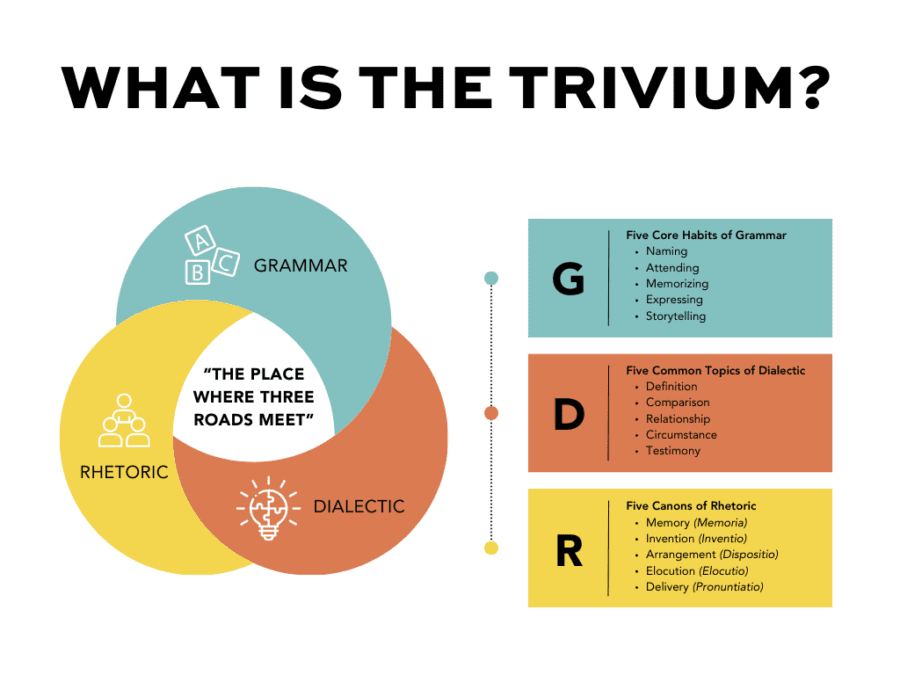
Grammar
Similar Note: Grammar of the Small Catechism
Every discipline or area of study has its own grammar. This grammar is more than just the core function of sentences and language structure. It is the basic vocabulary and pieces of knowledge you need to get around in that discipline (i.e. you need to know the parts of the body when working in medicine).
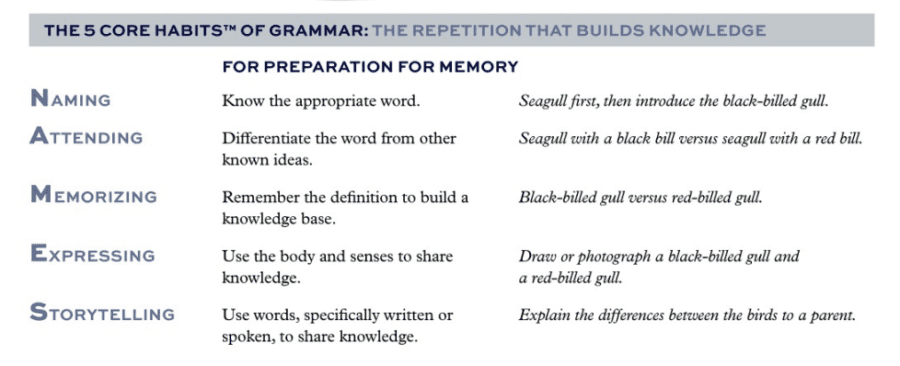 We want to be able to express and use the grammar of a subject not just regurgitate it. Therefore here are a basic list of the kinds of tasks that can help us learn grammar:
- Start by just Naming things and collecting the basic units of the grammar. Where are the verbs? What is the subject? What are things that confuse me or feel unexplained? etc.
- Then move to Attending looking at all the pieces and starting to see how they hold together. How are they organized? What changes the meaning of other things in the grammar? etc.
- Start to Memorize the core pieces of grammar as well as their differences. As you build that base you will be able to start bringing what you see with you into other sections.
- Expressing is then the next stage. How to you start to put these things into your own words or how would you show them to someone else? Can you learn a song or poem or piece of liturgy that expresses these things?
- Storytelling is using what you have learned to tell a story or bring it to life somehow.
Logic
How are you able to think clearly about the subject and discipline.
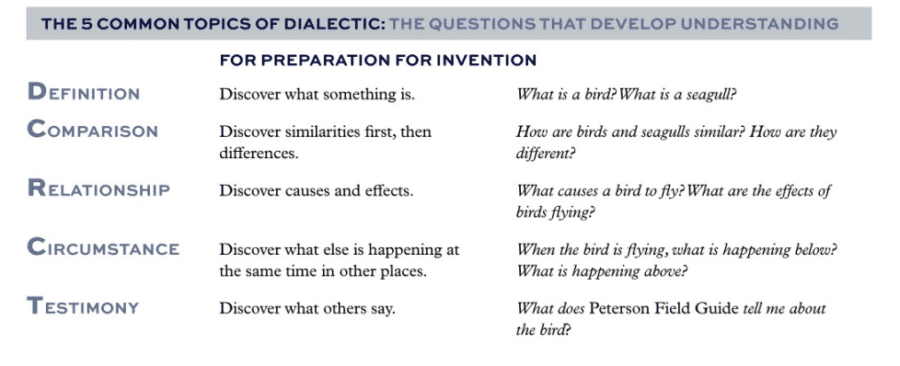
- Definition - How do you categorize or define things? Each category makes a choice about how things hold together and shapes the way we see things. Where did these categories come from? Are there other ways to categorize the same thing?
- Comparison - How are things similar, or different or to what degree are they similar or different?
- Relationship - How are things related to one another? or how do they affect each other?
- Circumstance - is something possible or impossible to figure out with the information you have? when or when will the thing under consideration happen?
- Testimony - what kind of source are we working with?
- Authority – An expert in a subject
- Testimonial – Given by someone who witnessed an event firsthand
- Statistics – Quantitative data supporting an argument
- Maxims – Common knowledge
- Laws – A type of testimony encoded in writing and said to be binding
- Precedences – Evidence through past example
Rhetoric
How can you communicate what you know and persuade others toward the truth?
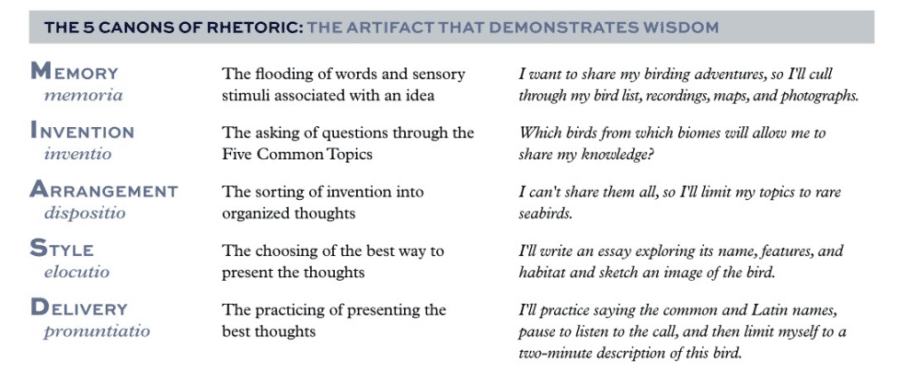
- Invention - What should I say? Brainstorming and research and planning.
- Arrangement - In what order should I say it? get things in a logical and clean flow.
- Elocution - How should I say it? what style or method would be the most persuasive to the audience I am trying to reach and how can I deliver it that way.
- Memory - how does what I have memorized or have in my memory relate to this and how will I use it or add it to my memory?
- Delivery - How should I present this truth in speech and action? the actual writing or speaking of the idea to your audience
Classical Note Taking System
Here is a good article about taking notes with the trivium as the guide: Classical Note Taking Method
Use Method
Grammar Stage
Note-Taking Phase 1: Recall
Time Range (Examples): 2-6 minutes
What It Accomplishes: Forces honest retrieval of information pertaining to your study (i.e. everything you remember from a previous session, book chapter, lecture, etc.)
How to Do It: Spend time writing all of the information that you remember, starting in the Recall column on Page 1.
Note-Taking Phase 2: Initial Notes
Time Range (Examples): 7-23 minutes
What It Accomplishes: Raw, faithful capture and active interrogation of the new material, including every confusion, wonder, contradiction, or doubt that pops into the learner’s mind.
How to Do It: After the Recall Phase, begin writing down all of the most important information regarding the subject and your understanding of it, taking mental notes of questions that arise during your initial interaction with the material.
Logic Stage
Note-Taking Phase 3: Reasoning and Questions
Time Range (Examples): 7-18 minutes
What It Accomplishes: Dialectic, discursive, productive struggle with the new material to begin making sense and memory.
How to Do It: After your notes have been taken, begin wrestling with the information by writing down any questions that are relevant to your understanding of the subject, and applying techniques that not only force you to recall the material (i.e. refraining from looking at the previous stage), but also rationalize it in a way that transforms it into deeper understanding.
Some examples of techniques to use during this stage:
Concept mapping
identification and paraphrasing of key arguments/ideas
Practice with the material
Rhetoric Stage
Note-Taking Phase 4: Summary and Synthesis of Knowledge
Time Range (Examples): 4-13 minutes
What It Accomplishes: Solidifies the newly studied material into memory that is the learner’s own.
How to Do It: Refraining from any of the source material or notes taken in the previous stages, apply techniques that help you convert your understanding of the material to more cohesive knowledge that sticks with you.
Some examples of techniques to use during this stage:
Summary of the content in your own words, ranging from a single sentence to multiple paragraphs.
Construction of analogies
Soliloquy (dialogue with yourself about the information)
Suggested Books by Dr. Lane and Dr. Hensley
Consortium for Classical Lutheran Education
Lutheran Education-From Wittenberg to the Future
Loose Notes
The Definitive Formalization (c. 410–420 AD)
Martianus Capella, in his allegorical work De nuptiis Philologiae et Mercurii (“On the Marriage of Philology and Mercury”), introduces the Seven Liberal Arts as seven bridesmaids. This is the first time they are explicitly grouped as a complete set of seven.
“At this, a certain young woman of great beauty and majesty entered… she said she was Grammar… After her came another, a bit more sharp-tongued… this was Dialectic… Then came a third, of even greater splendor, called Rhetoric.”
Capella then introduces the remaining four (the Quadrivium) in the subsequent books:
“The four following sisters—Geometry, Arithmetic, Astronomy, and Music—who, though they deal with numbers and measures, are no less essential to the wedding of the Mind.”
The Naming of the “Trivium” (c. 750–800 AD)
While Capella grouped the seven, the term Trivium (the “three ways”) was actually coined later, during the Carolingian Renaissance, likely by Alcuin of York or his contemporaries.
In his work Grammatica, Alcuin writes:
“By these (seven) steps of the liberal arts, philosophers have reached the heights… Grammar, Rhetoric, and Dialectic form the triple path (trivium) to the secrets of language; Arithmetic, Geometry, Music, and Astronomy form the fourfold path (quadrivium) to the secrets of nature.”