The Big Idea
I am particularly interested in thinking of the temple vision of Ezekiel as a way to remember scripture spatially.
Ezekiel’s Temple Vision (Chapter 43 to 48)
Bible Project Walk through
https://bibleproject.com/classroom/ezekiel/modules/6
Very through commentary on the book of Ezekiel by Daniel Block
Notes from Session 25 -
The temple vision has three sections that each then have three subsections
Only matched in blueprint depth and description by the original plans for the tabernacle
Nightmare temple is described at 8:1-11:25 Ezekiel is in Babylon when he sees this horrible temple
Garden has tiers of sacred space getting closer and closer to God and His Prescence Gen 3:7-8 after the fall Adam and Eve hear God walking in the garden in the literal “wind (ruah) of the day”. When God shows up there are wind and sound (or voice)
Gen 6:9 Noah walks with God. The image of meandering along with God or going on a walk about.
Gen 13:14-18 Abraham and Lot parting ways. Promise of land and invitation to walk about the land.
When God gives his people a gift of an Eden he invites them to take a walk with him in that sacred space. And one of the ways to experience that is the pay attention to it’s dimensions
Ex 24:15-18 Mount Sinai. God comes in a cloud and Moses waits and enters the cloud on the seventh day. Moses is then enveloped by God’s glory at the top of the mountain.
Ex 25:1-9 The next things that happens is Moses hears the voice of God. And receives the pattern of the place God is coming to live with the Israelites. Moses sees the pattern from God. Everything is given by it’s length width and depth happen in super tight formation here in the patterns. All a long meditation of God’s presence.
1 Chronicles 28:1-18 David wants to build the temple and calls it the footstool of God. Sets things up for Solomon to do it and gives Solomon a plan (same word as pattern for Moses). Lots of details about how the temple should be laid out and what it contains.
All of this points toward taking a pause to ponder and imagine what it is like when heaven touches earth.
Ezekiel 40:1-4 God brings him to a really high mountain. temple is on the south face of the mountain. Meets a man that is going to show it too him. They are gonna do a walk around the new temple.
Only one object gets a vertical height which is the outer wall. It is all about getting a mental map of the space. It is all about God wanting to live with His people and how the spaces relates with each other is all about that message.
But this vision is never called a pattern which is the que for going and building something. But this is not a temple built with human hands. Ezekiel is seeing something that already exists not something that needs built like the past temples.
This is an interesting entry point for the purpose of physical liturgy. the core idea is walking with God physically and spiritually. The core idea of being in God’s presence is walking.
Key Points from their notes:
- In the design of the Ezekiel scroll, Ezekiel’s temple vision in chapters 40-48 links back to Ezekiel’s visions and the corrupted temple of chapters 1-8.
- Passages describing the dimensions of the tabernacle or temple provide readers with the opportunity to meditate on the space where Heaven and Earth are one.
- God gives Moses and David a “pattern” of what the people will build, but God shows Ezekiel a completed temple.
Notes from Session 26 -
40 - 43 After he goes on the tour he then sees the glory of God show up to the new temple in 43:1-12 This section tells what the point of the tour is and what he is supposed to do with the vision.
40:1-4 The temple vision comes when he is turning 50 which would have been the year of his retirement if he had served in the temple. the vision comes on the day of atonement.
Ezekiel’s vision occurs at the midway point of a Jubilee cycle
to the south is a city but he is on a very high mountain. different than Jerusalem temple is at the center. going to get shown around so that he can announce what he sees.
- The 25th year of exile
- On the Day of Atonement
- Sabbath year every seventh day of attornment
- 50th year is the Jubilee year
The Number 25 in Ezekiel’s Temple Vision1
- The entry gate houses are 25 cubits wide.
- The distance between the outer and inner gate houses is 4 x 25 cubits.
- The whole temple compound is 20 x 25 cubits.
- The total number of steps by which one ascends 100 square cubit inner court comes to 25.
- The facade of the court outside the north gate was 4 x 25 cubits long and 2 x 25 cubits wide.
- The outer wall of the outer court ran 2 x 25 cubits.
- The entire central “reserved land” is 25 x 1000.
- The outer wall surrounding the temple complex is 500 cubits squared.
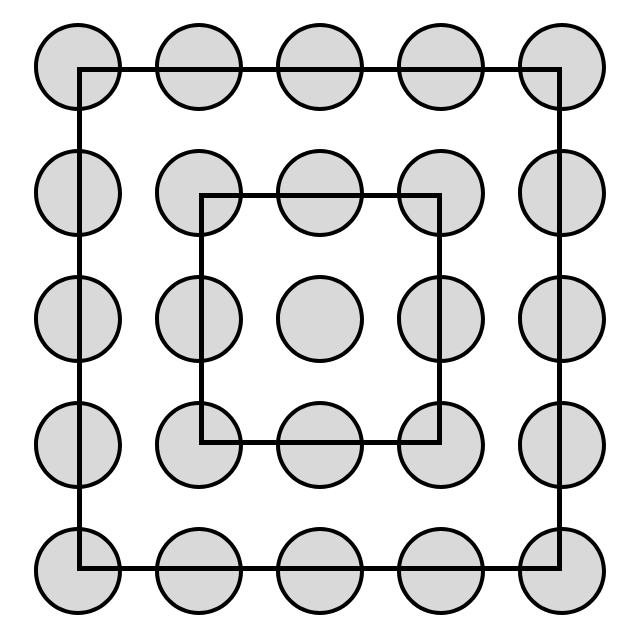
Bergsma, “The Temple as ‘Built Jubilee’”
“What is the significance of this date for understanding the rest of the vision (chs. 40-48)? The deportees, in a sense ‘half-way’ through the exile, would be feeling the discouragement associated with ‘mid-time,’ and in need of a word of hope from the Lord. Ezekiel provides that in his vision. On the Day of Atonement—on which the old temple would have been cleansed and the Lord would have renewed his presence therein—Ezekiel foresees a new, cleansed temple to which the Lord’s presence returns … By building the temple according to the jubilee number fifty, Ezekiel suggests that the temple in some sense is Israel’s jubilee; that is, it is in proper worship of the Lord that Israel experiences her true freedom … The entire vision of restoration in chs. 40-48 are an eschatological proclamation of the jubilee on the Day of Atonement.”2
Everything in the vision is focused on purifying Israel form everything had happened before. This is the design of the space, organization, personal and the identities of the people who are working.
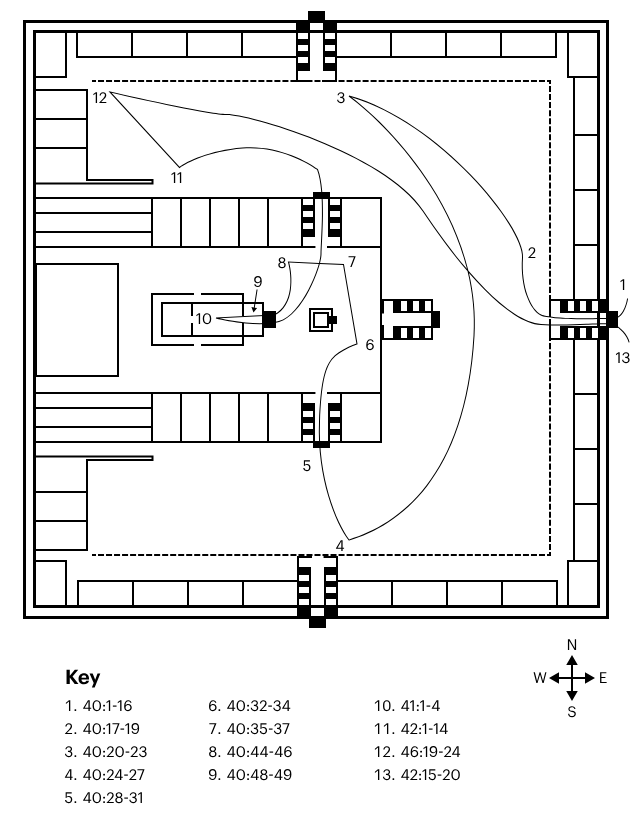 Chart from Daniel Block’s Commentary
Exile from Eden is to the east. When Yahweh comes back to this temple he comes from the east. Start tour at the east gate as well.
Movement in to holier ground.
Sees garden palm trees all around the inner walls of the sanctuary
Steps outer gates 7 inner gates, 8 steps temple, 10 steps. Totals 25 steps to get all the way into the most sacred space.
The whole temple is super symmetrical and even. In the ancient world symmetry was a lot less frequent than now and it communicated an order and safety to the space. Matches with the symmetry of Gen 1 as well.
the altar is at the very center of the whole temple complex. Altar is the daily meeting spot that any Israelite could bring an offering to. The holy of holy’s is the special meeting place once a year.
The measurements of this temple are way bigger than any one that was built in Jerusalem.
Second temple did not use this vision as a blueprint even though they would have had it.
No cherubim are inscribed on Ezekiel’s temple because they are actually there.
Could compare and contrast differences between this temple vision and Solomon’s temple and the differences would be significant and meaningful.